

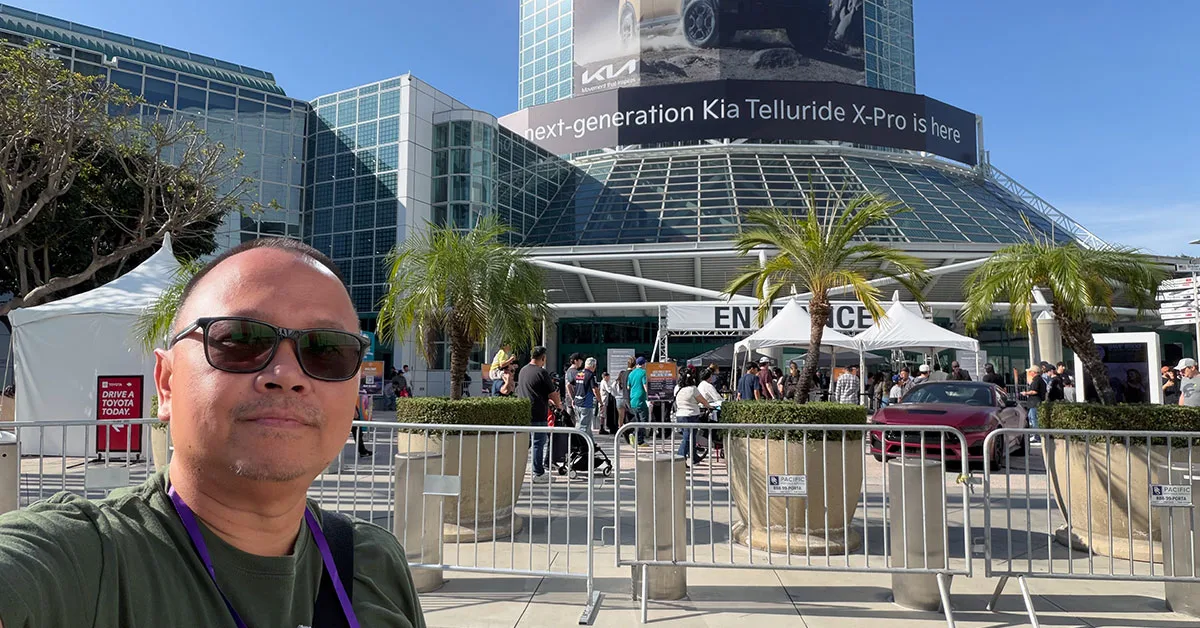
The Rivian R2 was at the LA Auto Show — and I finally got to stand next to one in person.
I went with the San Gabriel Valley Rivian Club. We caravanned to the LA Convention Center, paid the $32 parking tax that is apparently mandatory for any LA event, and made our way straight to the Rivian booth. But honestly, the R2 wasn’t the only thing worth talking about at this year’s show. Between the Scout reveal, the Jeep Recon, the ID. Buzz, and more minivans than I expected, there was a lot going on for anyone who thinks about utility and electric vehicles the way I do. Here’s what stood out.
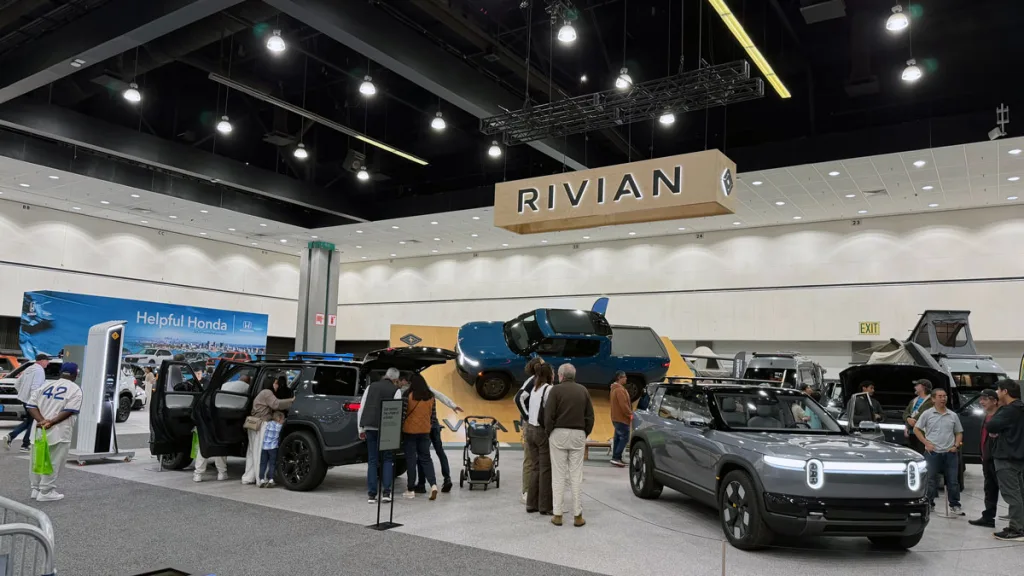
Rivian R2 at the LA Auto Show booth — front 3/4 angle showing the yellow accent trim, size comparison with R1S visible in background if possible. Convention center setting.
Rivian R2 LA Auto Show first look — smaller than you think
The Rivian R2 LA Auto Show display had both the R2 and R1S side by side, which is exactly what you want to see. The size difference is real. The R2 is noticeably smaller — not tiny, but if you’re coming from an R1S like I am, you’re going to feel it. They had it roped off so you couldn’t really get inside or push buttons, which was frustrating, but you could still get close enough to pick up on the details.
A few things I noticed right away. The interior looks more simplified than the R1S — the seats especially. But the UI on that screen? Bright, clean, different from what current R1 owners are used to. I’m hoping that’s a preview of an update coming to existing vehicles, not just the R2. The Knack port is in the right spot — finally in a location that actually makes sense. And this unit had yellow accents, which according to the Rivian rep on the floor, indicates it’s the tri-motor variant.
- Size: Noticeably smaller than the R1S — confirmed in person
- Trim on display: Tri-motor variant (yellow accents)
- UI: New screen interface, brighter and cleaner than current R1 gen
- Frunk: Button on the front bumper
- Flashlight: Still included, same as R1
- Outlets: Confirmed for trunk area, second-row outlets still TBD
- Camera: Mounted low on the front bumper, no LiDAR visible
One thing that caught me off guard — the door buttons have bright accent lights coming through them. My R1S doesn’t have that. Small detail but it looks sharp. Also spotted what looked like three horizontal lines near where the frunk button would normally be. Could be a touch-sensitive area like the charge port on the R1S. Nobody could confirm that on the floor.
Bottom line on the R2 in person: it’s legit. If you’re already an R1S owner wondering how it compares, I broke that down in more detail here — Rivian R2 vs R1S: my honest thoughts as a Gen 2 owner.
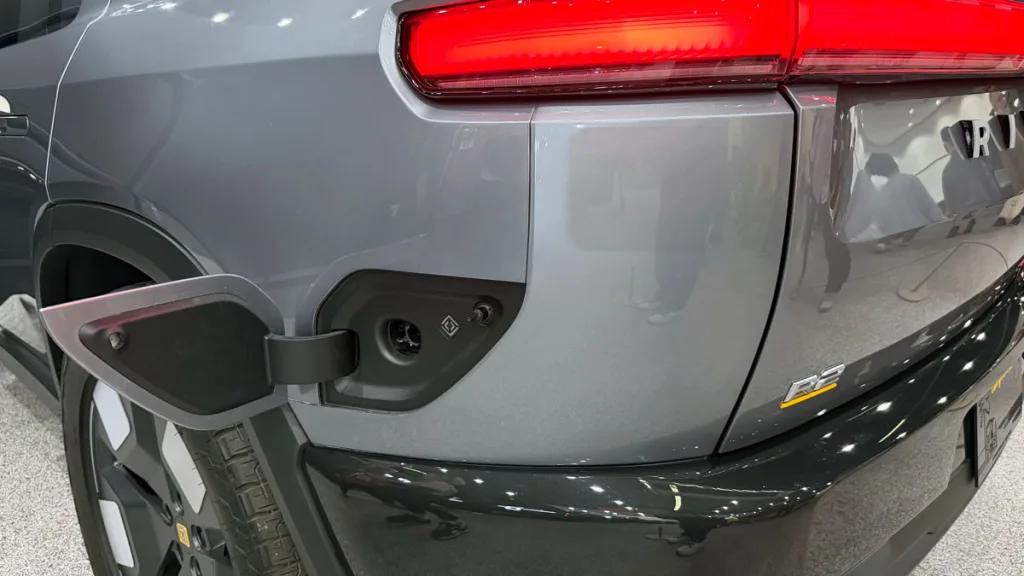
Close-up of Rivian R2 interior — center screen, NACS port location, seat design, and purple pedal lighting if visible. Booth lighting, not studio shot.
The R1T setup and the Rivian charger with NACS
The R2 wasn’t the only Rivian on the floor. They had an R1T set up with the iCamper rooftop tent and camp kitchen running off the rear outlets — the same outlets that both R1T and R1S have. Seeing the camp kitchen plugged in and running reminded me how much I actually miss my R1T. That truck did things the R1S just doesn’t. I traded it for the R1S Gen 2 and I’d do it again, but there are moments. If you want to know why I made that call, that story is here — why I traded my R1T for the R1S Gen 2.
Also on display: a Rivian home charger with a NACS port. V1.5, compatible with non-Rivian vehicles. That’s a big deal if you’ve been waiting on a NACS-native home charging option. If you own a Rivian and want to track your own vehicle stats and charging data, Rivian Roamer by Chad is worth bookmarking — I use it every session.
Scout Motors, Jeep Recon, and the EV truck conversation
The Scout booth was outside and it was worth the walk. Two vehicles — the Traveler SUV and the Harvester truck. Both have bench seating in the front, a flat floor, a steering wheel shaped like the Rivian’s, and an interior that genuinely surprised me. Real wood accents, a pull-out writing table in the second row, a sliding glass roof on the SUV version. The bed on the Harvester is spacious and the NACS port is accessible from outside the vehicle with 2,200-watt outlets at 120V.
Worth noting: Scout runs on battery but uses a gas generator as the primary energy source. So it’s not a pure EV — it’s a range-extended electric. Depending on what you’re looking for, that’s either a feature or a dealbreaker. I don’t have a reservation yet. Still watching.
The Jeep Recon Moab was also there — starting at $65,000, 230 miles of range, 650 horsepower, 0-60 in 3.6 seconds. Looks like a Defender in black. And here’s the honest take: at $65K, you’re close enough to R1S Dual Standard territory that the comparison is unavoidable. The R1S wins on range, software maturity, and real-world ownership track record. The Jeep wins if you’re already deep in the Jeep ecosystem and want something that looks like it belongs on a trail. Different buyers.
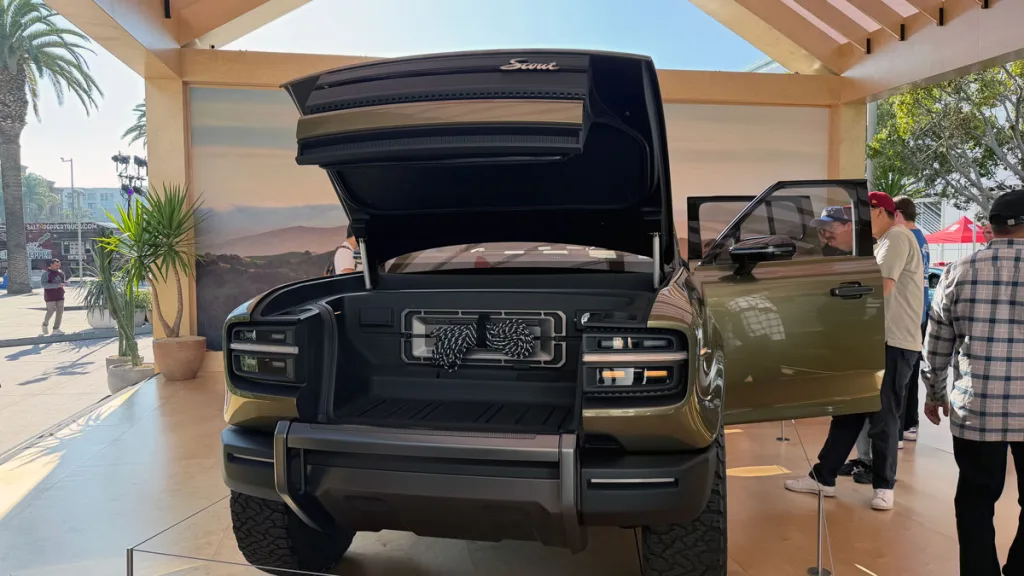
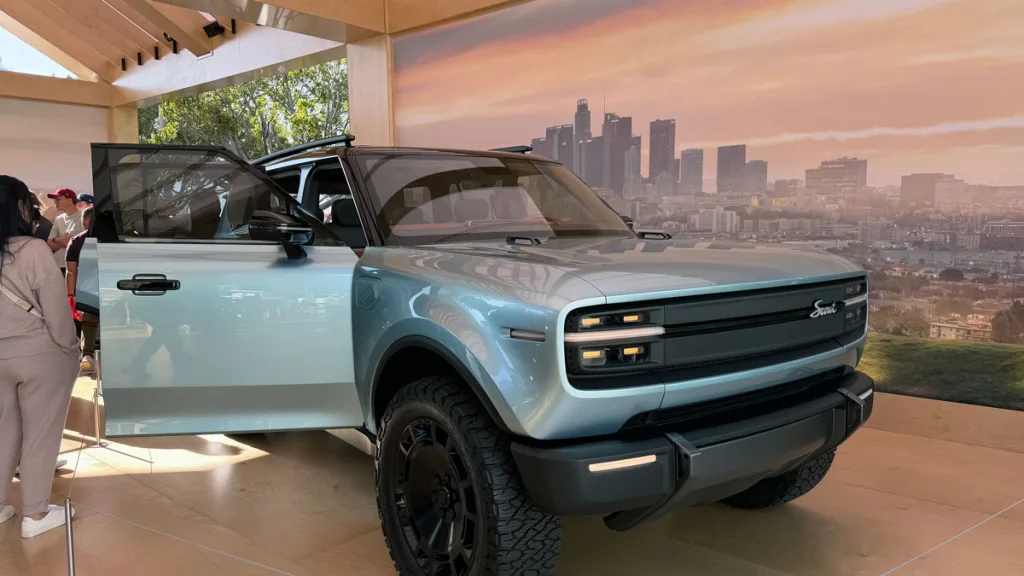
Scout Traveler and Harvester at the LA Auto Show outdoor area — exterior shot showing front design, or interior showing flat floor and bench seating. Natural outdoor lighting.
The minivan situation at the LA Auto Show
I can’t go to an auto show and not stop at every minivan on the floor. It’s a problem. But honestly — the minivan segment at this show was genuinely interesting.
The Toyota Sienna Platinum was there and the interior has come a long way since we owned one in 2013. Illuminated door sills, second-row footrests, screens throughout. Still a hybrid, not electric. Still no sliding electric minivan from anyone. My family went from a Sienna to a Honda Odyssey to a Model X to where we are now — Cybertruck and R1S. The R1S handles the seven-seat duty but it’s not the same as sliding doors. I keep hoping someone builds it.
The Chrysler Pacifica Grizzly Peak concept was also there — same one from SEMA. Off-road minivan, Rhino Rack roof setup, MOLLE panels inside, matte finish paint, orange interior stitching. It’s still a concept and may not make production, but I want it to. Imagine pulling up to a trail in a minivan. That’s content.
The Volkswagen ID. Buzz rounded out the minivan conversation — three rows, starts at $60K, sliding doors, and a Rivian software partnership on the way that could meaningfully improve the tech stack. The range and charging performance aren’t there yet. But in the used market at the right price? I’d park it in the street and call it my sixth vehicle.
The LA Auto Show Rivian R2 display was worth the $32 parking alone. The R2 is real, it’s smaller than the R1S, and the details I saw in person track with everything Rivian has been saying. Drop your questions in the comments — especially if you’re deciding between the R2 and holding out for the R1S.

Leave a Reply